
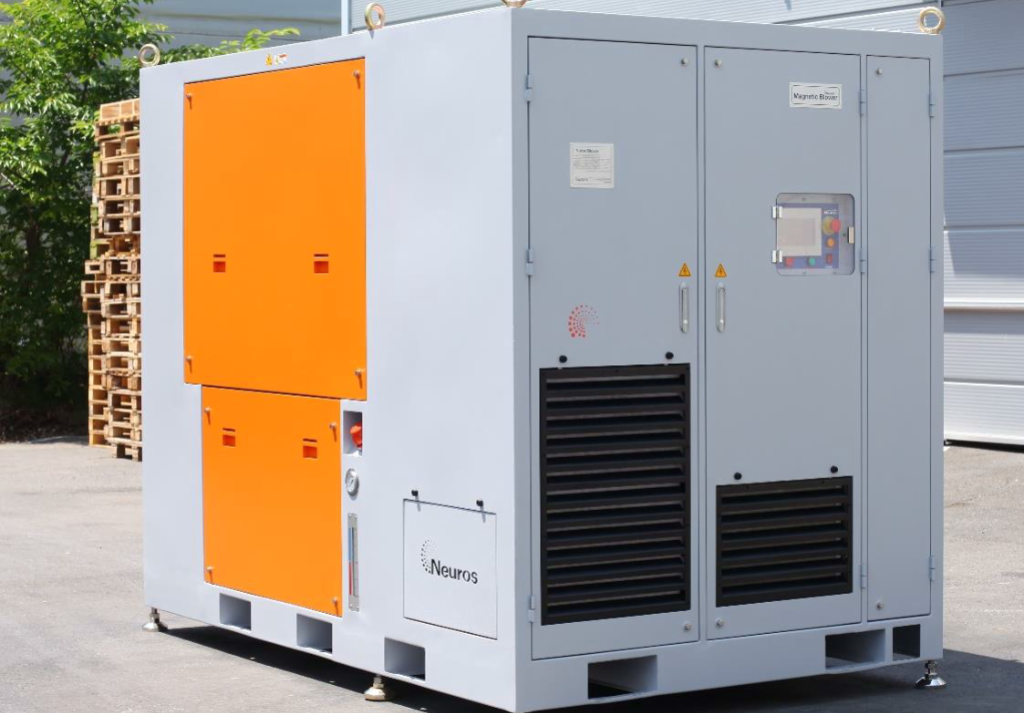
If you are specifying a high-speed turbo blower for your plant — whether for a sewage treatment facility, a cement conveying line, or a pharmaceutical ETP — one question comes up almost every time:
Should I choose an airfoil bearing or a magnetic bearing turbo blower?
Both technologies are a massive leap forward from traditional roots blowers or multi-stage centrifugal blowers. Both deliver oil-free, high-efficiency compressed air. But they are not interchangeable. The right choice depends on your operating conditions, budget, and long-term maintenance expectations.
At Usha Neuros, we manufacture both. We introduced airfoil bearing turbo technology to the Indian market and have since added magnetic bearing turbo blowers to our portfolio. We have installed these machines across wastewater treatment plants, cement plants, petrochemical facilities, and municipal infrastructure across India. This guide is our honest, technical take on both technologies — written so you can make the right decision for your application.
How Each Technology Works
Airfoil Bearing Turbo Blowers
An airfoil bearing turbo blower uses a thin film of compressed air to support the rotating shaft — no oil, no mechanical contact during steady-state operation. As the impeller spins up to high speed (typically 20,000 to 50,000 RPM), the air between the shaft and the bearing shell creates a pressurised cushion that floats the shaft and keeps it frictionless.
The design is elegantly simple: a high-speed permanent magnet motor, a precision aluminium impeller mounted directly on the motor shaft, and foil-lined air bearings that need no external energy source, no sensors, and no bearing controller to function.
At Usha Neuros, our NX Series airfoil bearing turbo blowers use bump-type air foil bearings developed in partnership with Neuros Co. Ltd. of Korea — the same technology trusted by municipal water boards, cement majors, and defence applications.
Magnetic Bearing Turbo Blowers
A magnetic bearing turbo blower uses electromagnets arranged around the shaft to hold it in a contact-free, levitated position during operation. Active sensors continuously monitor the shaft’s position and adjust the magnetic field in real time to keep the rotor stable — even during surge events or sudden load changes.
This active control system adds a layer of electronic complexity that airfoil bearings do not have, but it also gives the machine exceptional dynamic stability and precise impeller clearance control at all times.
Our NXM Series magnetic bearing turbo blowers deliver this technology with a completely frictionless, zero-maintenance bearing system for applications where uptime and vibration sensitivity are critical.
| Feature | Airfoil Bearing (NX Series) | Magnetic Bearing (NXM Series) |
| Capital cost | Lower | Higher (15–25% premium typical) |
| Energy efficiency | Very high | Very high |
| Surge protection | Moderate | High |
| Vibration | Very low | Extremely low |
| Noise level | Low | Very low |
Where Airfoil Bearing Wins
1. Budget-Conscious Projects Without Compromising Quality
Airfoil bearing blowers carry a lower capital cost than magnetic bearing units of equivalent capacity. For municipal corporations, state water boards, and private plants operating under tender constraints, the NX Series delivers exceptional efficiency and near-zero maintenance at a price point that fits within procurement budgets.
Across our installations at Delhi Jal Board, BWSSB, Gujarat Water Supply & Sewerage Board, and Kerala Water Authority, airfoil bearing technology has consistently delivered 30–35% energy savings over the roots blowers they replaced — without the premium associated with magnetic bearing systems.
2. Applications With Clean Operating Conditions
Airfoil bearings are ideally suited for standard industrial and municipal environments where power supply is stable, ambient temperature is managed, and surge events are infrequent. Wastewater treatment plants from 3 MGD to around 50 MGD, food and beverage aeration, pneumatic conveying in cement plants, and standard industrial blowing applications are all excellent fits.
3. Simpler System Integration
With no bearing controller, no external sensor network, and no complex electronics beyond the standard VFD and motor, airfoil bearing blowers are straightforward to integrate into existing plant control systems. Our NX Series arrives as a complete package — blower, motor, VFD, cooling, and controls in a single enclosure — ready to connect.
4. Lower Total Cost of Ownership for Mid-Range Applications
Airfoil bearing blowers combine a lower purchase price with near-identical efficiency and virtually maintenance-free operation. Furthermore, they help reduce long-term operating costs across mid-sized industrial applications. As a result, they often provide a better total cost of ownership than magnetic bearing units.
Where Magnetic Bearing Wins
1. Large-Scale Plants Where Every Percentage Point of Efficiency Matters
At power ratings above 200 kW, magnetic bearings provide tighter impeller clearance control. As a result, they can achieve higher efficiency than airfoil bearing designs. Furthermore, large municipal STPs, industrial WWTPs, and petrochemical plants operating 24/7 can benefit significantly. Even a 3–5% efficiency improvement can lead to substantial annual energy cost savings.
2. Environments Prone to Surge
Magnetic bearings actively monitor and respond to surge events in real time, thereby protecting the rotor and motor from cascade failures. Additionally, they continuously adapt to changing operating conditions, ensuring stable performance even during sudden demand fluctuations.
3. High-Altitude or Harsh Ambient Conditions
Above approximately 1,500 metres elevation, air density decreases enough to affect the performance of airfoil bearings. Magnetic bearing blowers, whose levitation is entirely electromagnetic and independent of air density, are the recommended choice for high-altitude installations — such as plants in the hills of Himachal Pradesh, Uttarakhand, or Jammu & Kashmir.
4. Extremely Noise-Sensitive Environments
Magnetic bearings produce virtually no mechanical vibration. For installations in or adjacent to populated areas, hospitals, or noise-sensitive industrial zones, the < 80 dB noise floor of magnetic bearing blowers provides an operational advantage.
5. Applications Requiring Zero Maintenance Over Extended Periods
With no physical contact between any rotating parts whatsoever — not even during startup — magnetic bearing blowers achieve true zero mechanical wear. For remote installations, unmanned stations, or plants where access for even routine checks is difficult or costly, this is a meaningful operational benefit.
The Question of “Power Quality” in India
This is a practical point that matters specifically in the Indian context and is rarely discussed openly.
Magnetic bearing systems depend on continuous, stable power to maintain the electromagnetic field that keeps the shaft levitated. If your plant site experiences frequent voltage fluctuations, unstable grid power, or is in an area with poor power quality, a magnetic bearing blower will require additional power conditioning equipment — adding to your capital and installation cost.
Airfoil bearing blowers are considerably more tolerant of real-world power supply conditions. The air cushion supporting the shaft does not disappear the moment power flickers. For the many Indian industrial and municipal sites that fall outside Tier-1 city grid reliability, this is a practical consideration worth factoring into your decision.
Which Should You Choose? A Simple Decision Framework
Choose an Airfoil Bearing Turbo Blower (NX Series) if:
- Your project is budget-sensitive or operating under tender constraints
- Your plant is between 3 MGD and 50 MGD (WWTP) or equivalent industrial scale
- Your site has standard grid power and a managed equipment room
- Your application is wastewater treatment, cement conveying, food and beverage, textile, or general industrial blowing
- You want near-zero maintenance with a simpler, proven system architecture
Choose a Magnetic Bearing Turbo Blower (NXM Series) if:
- Your plant is large-scale (above 200 kW per blower unit)
- Your process involves highly variable or surge-prone air demand
- Your site is at high altitude or experiences extreme ambient conditions
- Noise levels are a regulatory or community concern
- You need true zero-maintenance operation for remote or unmanned installations
- Your power supply is clean and stable
Both Technologies. One Manufacturer. One Source of Truth.
Most manufacturers in India offer one or the other. Usha Neuros manufactures and services both — which means our recommendation is based on your application, not on which product we happen to stock.
As the pioneers of airfoil bearing turbo technology in India and the only facility in the country with in-house ASME PTC-10/13 standard testing, we bring over seven years of field data, hundreds of installations, and a direct lineage to Neuros Co. Ltd. of Korea — one of the world’s leading turbo blower technology companies.
Whether your next project calls for an NX Series airfoil blower or an NXM Series magnetic bearing unit, our engineering team will help you size it correctly, match it to your application, and support it for the life of the machine.
Ready to decide which technology fits your plant? Talk to our engineering team — we will review your application parameters, power supply conditions, and budget to recommend the right solution.
Contact Usha Neuros


